Sunday, September 15, 2013

Ushuaia, Land of Marriage Proposals

Alright, when I left off I believe we were just rolling through the gate of Ushuaia, the southernmost city in the world, and the literal end of the road. It was a really nice place, and actually looked about like I had imagined...


Though we had made it to Ushuaia we weren't quite finished, as the actual end of the road is in Bahia Lapataia National Park just south of town. It's not advisable to go there without the necessary supplies... of champagne. 

After a quick stop at the grocery store for two bottles of Argentine bubbly and we were off for the park. Unfortunately for us, the park didn't have a "furthest distance traveled" award, and our $30 per person entry fee was not going to be waived. As absurd as this probably sounds, we actually decided - after riding from Kansas to Argentina - to not ride the last ten miles of the road in order to save the $60. $60 was close to a day's budget. It was 5:45PM, the park was closing at 6:00. We were turning around to leave when the park attendant ran up to us and told us that when she left in 15 minutes, there would be no one watching the park entrance for the rest of the night. Maybe she agreed that it was a bit silly for the government to call the last ten miles of the 29,000 mile Pan-American highway a National Park and charge people $30 a head to take a picture with the sign.

We thanked her for the information and headed back toward Ushuaia to find a place to stay. That too, would be more difficult and expensive than we had anticipated. Private hostel rooms were going for $90 a night! We tried every place we could find, but they were all the same. It seemed that the hoteliers of Ushuaia had (wisely) formed a sort of cartel, and agreed to charge around three times the going rate for similar lodging elsewhere in Patagonia. Frustrated with the situation we decided to head back to the park, as it was now around 7:00 and the park would be closed (open). At that point in the day we were both in pretty low spirits; money anxiety had been with us for a while, and between the park fees and the lodging prices our "end of the rainbow" dreams of Ushuaia were crashing back to reality.

______________

An unmentioned subtext of this entire trip is my intention to strand Jill in a remote region of South America and thereby force her to marry me. The reasoning behind this shouldn't be a big shock to anyone who has been reading along and watching her super-human ability put up with all of the insanity this trip dished out. I loved Jill the first time I saw her, and seeing her smile and laugh as we rumbled through South America for seven months, living out of a box smaller than a carry on bag (!) convinced me all the more. All along I had been planning, and had actually settled on proposing to her San Carlos de Bariloche... until we arrive and it looked like this:


Instead of this: 

http://photo.accuweather.com/photogallery/details/photo/30494/Argentina+++San+Carlos+de+Bariloche
Not wanting to get down on one knee in two inches of post-apocalyptic volcanic ash, I postponed the proposal. The long days of bad roads, insane crosswinds and rough mining towns in Patagonia didn't seem fitting either. So the next logical location was Ushuaia - but it wasn't cooperating.

______________

When we arrived at 7:15 the park gate was abandoned, as promised. We headed in and made our way to the end of the road. Shortly after we arrived a park ranger rolled up in a pick up with two passengers. For a minute I thought we were about to get busted, but he smiled and waved as he walked over to us, and offered to take our picture with the sign. 


He then took a photo of his two guests with the sign and headed off in another direction... it seems that after hours visits were not as criminal as we had feared. From then on we had the place to ourselves, so we popped our champagne and settled on a small hilltop to celebrate our arrival. 


Between those two photos, looking out on the bay toward Antarctica, Jill accepted my proposal! It was an amazing feeling that I'm not really able to do justice in writing, sorry! We laughed giddily and drank another bottle of champagne as the sun went down and then rode back to town, where we happily paid the very reasonable $90 for a private room. 


Saturday, January 5, 2013

Tierre del Fuego!

(The first and second of November, 2011)
Tierre del Fuego "Land of Fire" to the left. Well, that sounds nice!
As we made our way toward Tierre del Fuego, the landscape changed from mountains and valleys to flat, tan, grassland. The wildlife got a bit more interesting as well...
The "Rhea" by the fence is a relative the Emu and the Ostrich
These are Alpacas, a species characterized by their total disregard for traffic conventions and inability to grasp simple concepts like right-of-way.


I'm not sure what type of animal this sign represents, but I'm thankful that we didn't encounter one. Actually, this sign warns of high winds, as said high winds have resulted in the total lack of actual trees to make them more apparent. Helpful for people who can't figure out why they are constantly flying off the left side of the road, I guess. 

We then faced a border crossing, from Argentina to Chile, which we would perform four times in the next week. At least it was a quick, streamlined procedure to allow people from Argentina easy access to Tierre del Fuego and Ushuaia. HAHA! NO it wasn't! There is some sort of old feud between Chile and Argentina with regards to control Tierra del Fuego, and Chileans really, really enjoy messing with people who are headed down there. It's not the dangerous feeling, malicious sort of border harassment we faced in Central America; it is more of the bureaucratic, "declare and then throw away that banana" Chilean border nonsense we've grown to love. Our bike was searched (for the first time since northern Mexico) and we were needlessly delayed. Whatever. 

On to the ferry! 
"Welcome to the Strait of Magellan"


Less fiery than advertised.

The ferry ride was short and trucker-filled, as usual. We disembarked, and only a few miles down the road ran into Wilson, our Irish friend from a week ago. Meetings like this seem remarkable in such a huge landscape, until you remember there are is only road to the ferry. It was still nice to see a familiar face! 

Unfortunately, getting to Tierre del Fuego is not getting to Ushuaia, and we still had a day and a half of riding to do, and the only mandatory dirt riding of the trip. (We did tons of dirt riding over the course of the trip, but this was the only time there was no paved option.) Having been delayed at the border, it was too late in the day to ride the 80 miles of dirt to the next Argentine border, so we found a place to stay in a tiny village called "Cerro Sombrero"


The beautiful environs of Cerro Sombrero. They originally wanted $100(!!!) for one night in the main building, but we ended up getting a $50/night room in the miner's quarters (above) and the spectacular view from our window made it all worthwhile. Think of it, if you lived here, your address could be (in English) "100 Main St, Hat Hill, Land of Fire, Chile" That would be the best perk of living here. 

The next morning we were back on the (dirt) road, headed for Argentina, and reasonable prices. But not before a tank of Chile's finest, $9/gallon gas. We had been warned not to stop in this part of Chile because of the prices, but because of the delay at the border, we had no choice. I'm sure it was all a coincidence. 
The dirt road was no coincidence, either. A native Ushuaian told me that the Chilean government refuses to pave the 80 mile main road in Chilean Tierre del Fuego because the Argentine government will not lay a natural gas line from Ushuaia to Chilean territory south of Ushuaia, keeping Chile from opening a port there and securing Ushuaia's position as the southernmost city in the world. International relations at their best! 

Back to the trip...

Poor little rascal, the only black sheep we saw in thousands of white sheep...

This guy was there to look out for any sheep who were slow and needed "assistance"

The place felt huge, and though it was extremely windy, it was beautiful.
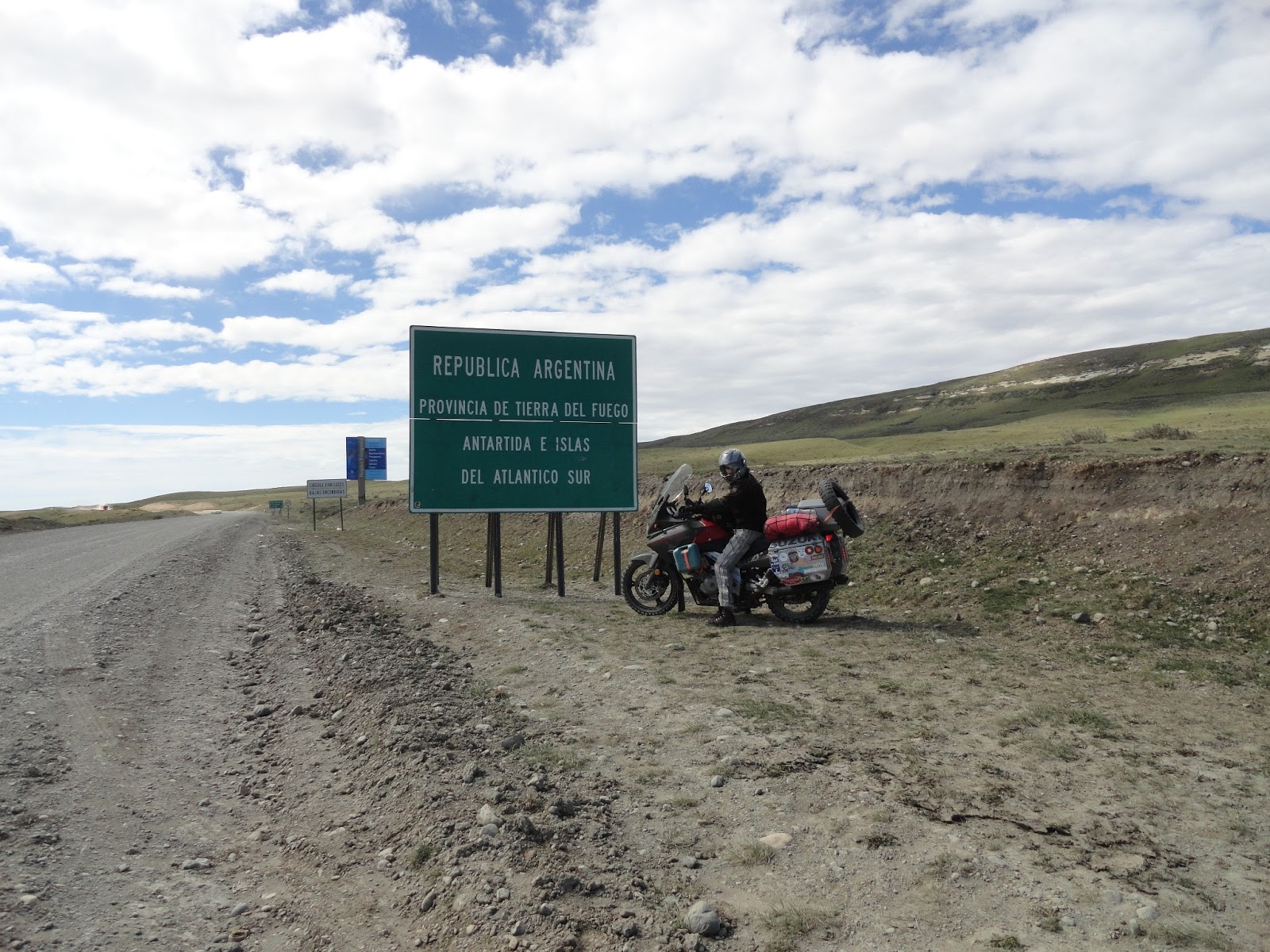
Back to Argentina, the last border to cross while headed south

Tierre del Fuego has been home to sheep ranches since the early 20th century, and outnumber human inhabitants by at least 50 to 1. 

Being November, late Spring, every ewe in sight had a young lamb in tow, and often the noise we made while passing sent the lambs running for their mothers. It was funny to watch 50 lambs run in every direction, right to their respective mothers (who all looked alike to us) without any pause or confusion. We weren't trying to scare them, but it seems they don't get many visitors. 

As we approached Ushuaia, mountains shot back up from the plains, and it soon looked like we were riding somewhere between Vail and Aspen...


We rode along on the beautiful highway in awe of the snow capped mountains and rich blue lakes, and only vaguely aware that we were nearing the end of the ride south, which we had started six months and 18,000 miles earlier...


We came around a corner, and we were there. 

Still in El Calafate

Back from the awe-inspiring glacier, it was time to get the bike ready for the last southbound leg of the trip - southern Patagonia. The preparations entailed cleaning the air filter, reversing the rotation of the front tire (to improve wear) and replacing the rear tire. This would all be done in the hostel courtyard, with hand tools, and then we would stop and buy oil for one last oil change when we got a chance.
2000 miles of bugs and debris in the air filter; the pleated portion is supposed to be bright pink. 

One more $250 rear tire for the upaved, Chilean portion of the road to Ushuaia

Almost done! I would really like to thank the designer who put the air filter under the fuel tank. 
That night we met up with Bernard and Annemarie, the Belgian couple who built and piloted "Brutus" the monstrous RV pictured a few posts back...

Over the last few years, Bernard and Annemarie built Brutus from the ground up, starting with a used 10 ton 4x4 industrial truck chassis and an insulated delivery truck box. Bernard designed, built, and wired the entire thing himself, with much of the interior woodwork fashioned from wood he felled and aged specifically for the purpose. It was an incredible machine, fully self-contained and capable of traveling on any type of road (or lack thereof) in any weather conditions - from the arctic to the desert. They are currently traveling on an open-ended tour of South America, and were some of the kindest, most welcoming people we encountered.

We shared dinner and drinks, and the next day we were off our separate ways again, Jill and I reassured that  there are new friends around every corner, and that there will still be exciting travel in store after we no longer want to sit on a motorcycle all day.

ONWARD! To Tierre del Fuego!

Monday, October 22, 2012

El Calafate/Perito Merino, about a year after the fact...

Ok, so it has been an absurdly long time since I wrote anything, so I doubt anyone is still reading this, but we'd like to have it to aid our own memories.

Last time we were headed toward El Calafate and the Perito Merino glacier, so here it is! This was our first glimpse of it as we rode into the National park, which cost us a paltry $25 a person; or 2/3 of the day's budget. The road was spectacular, and we started seeing ice chunks the size of houses floating in the lake long before the glacier itself came into view. The viewing area for the glacier was beautiful; all galvanized steel and hardwood and looked like it was five years old, tops.
There were multiple decks which overlooked different parts of the glacier, which is actually much, much larger than what you can see from ground level.

The "A" and "B" represent both ends of the veiwing complex, which are at least a quarter mile apart. From them you can see most of the glacier where it meets the water, but, as you can see, that is just "the tip of the iceberg" *gag*
So, from where you stand, there is a little of this:
I guess it's not "a little" - the ice wall is around 200 feet tall. 
A little of this:

And behind it, quite an amazing amount of this:


To attempt to give this some sort of perspective, the towers and crevices in the last photo are probably about the size of 20 story buildings, and, as you can see in the preceding photos, they go on for miles. Absolutely breathtaking.

Back at the business end of the glacier, these 200' tall spires are constantly "calving" and cascading into the water below; hundreds of times a day, as they have for thousands of years. Of course, it usually happens just after you turn your back, or right after you put your camera away, so we didn't capture any massive falls on video, but here's a link to a video that can give you an idea of what it looks like: Perito Moreno Collapse.

We spent most of the afternoon hanging around the various viewing areas of the glacier, and got a few parting shots from the parking lot:


Saturday, February 18, 2012

Travelers on the Road to El Calafate Oct 27-30


Our night of revelry in Trevelin was not without consequences, but luckily we hadn't been planning on an early morning departure (imagine that...) Once we did get up and around, it was back through Esquel and southeast toward Commodoro Rivadavia, all the way across the country, and most of the way across the continent. Luckily, this far south that's not really all that far. Our next actual goal was El Calafate glacier, around 880 miles away, so we checked the maps for good stopping points and set out.

I guess it's still kind of far...if you're not used to riding 500 miles a day...
I made this little map to show what we were up to. We started out for Comodoro Rivadavia at around 11am, for an easy 320 mile ride to the other coast. We would arrive at a decent hour, spend the night there, and ride to Rio Gallegos the next day - a short ~500 mile jaunt along what was rumored to be the windiest stretch on the continent. On the third day, we would ride the last 160 or so miles to El Calafate, to see the glacier. This route was as circuitous as it looks, and yes, there is a road that goes straight in between. Route 40 would have taken us right along the eastern edge of the Chilean Andes, close to the famed Torres' del Paine range and through some of the most remote, breathtaking territory in the western hemisphere. It is also known for it's outrageous winds and horrendous road conditions. A fresh, first hand account from another motorcycle traveler near Esquel sealed the deal for us.

"500 miles unpaved, very few other vehicles, very little gas, 60 mph cross winds and six inch deep tire ruts with softball sized rocks on each side."

NOPE.


I'm sure it would have been amazing, and people who had done it in 4x4s have told us as much, but six months into a largely problem free trip, two up on an 800 pound bike, was not the time to push our luck. The riding between Comodoro Rivadavia and Rio Gallegos made us feel even better about our decision to take the flat, straight paved road...

TREACHEROUS CONDITIONS (not pictured - 60mph crosswind)
The wind was at our back as we headed east for most of the day, but when we turned south we got a taste of what awaited us further south - the notorious Patagonian wind. As we approached Comodoro the Atlantic ocean came into view, a common sight in Central America, but one which we had not seen since July, in Columbia. We quickly found the downtown but finding a place to stay was another story. The only reasons people come to Patagonia are mining and tourism, and lodging comes at a premium. We spent an hour talking to every hotel in town, and finally broke down and paid the $50 it seemed to cost. The "El Refugio" motel was back out on the highway, and turned out to be about the best appointed room we had on the trip - WiFi, Cable, great beds, a BATHTUB with HOT WATER, the list goes on... The next morning we were well rested and ready to continue south down the east coast. As we were filling up I saw a rather strange looking machine - it had all of the makings of a Suzuki DR650, but something was a bit strange...oh, that's an eight gallon BMW GS fuel tank. Inside the station we found Wilson, an Irish adventurer and inventor of this Suzuki DRGS 650 Adventure. It turned out that he was heading south as well, so we set out toward Rio Gallegos together.


Wilson, a fellow traveler
A strange resemblance? Maybe it's just the helmet head...

That day the road might as well have been I-70 through Kansas, perfect pavement, great visibility and straight, straight, straight. By 11am things had started to change, though. The wind was coming up, and it's power had Wilson and I, both seasoned riders, sweating and fighting to stay on the road. Jill and I had been impressed and a little unnerved by the wind in the northern Peruvian desert, but it had NOTHING on the wind in Patagonia. For most of the afternoon it came from our right, constantly threatening to blow us into the steady stream of semi trucks coming the other way. We spent most of the day going between 40 and 50, and even at those speeds I was leaning and turning so hard into it that the front tire was on the edge of losing traction; there were times I HAD to go into the other lane to avoid leaning so hard that the front tire slid out. I still can't believe it, and looking back it was easily the most dangerous day of the trip and probably our lives. But we're alive, so there's no need to talk about that! 

The wind was taking a toll in more ways than one, and all day I watched in horror as the notches on the gas gauge disappeared at nearly twice their normal rate. Fighting the wind was costing us serious fuel consumption, and between Fitz Roy and Tres Cerros, for the first and only time on the trip, we RAN OUT OF GAS. Not in Colombia, not in Peru, not lost on a sandy back road in Bolivia. Well, at least I got to use the spare gas we had been hauling around for the last 3,000 miles, and it was plenty to get us the remaining 30 miles to the station. Wilson was right behind us too, and his backup was a luxury we hadn't known since we last saw Andy and Cass in Peru. Miss you guys! Anyway, at 40 miles an hour the 500 miles to Rio Gallegos wasn't happening, especially considering that my arms (and everyone's nerves) were like jelly after about 200. It was getting dark by the time we hit 300 miles, and it was time for gas yet again. At the YPF station in Comandante Luis Piedrabuena ("Commander Louis of the good stone?") the attendant told us that there was a great free campground five miles up the road. We checked it out, and it was great. The official camping season didn't start until the next day, so it was open, but free instead of $15 a person. The first free lodging since Costa Rica! We set up camp next to Wilson and we all crashed out early in hopes of beating the wind in the morning. 
Cherry Blossoms! 

Free camping, but B.Y.O.C.P. (Bring Your Own Communist Propaganda)
After a good night's rest we were off again, and so was the wind. It was pretty much as bad as the previous day, but we didn't really have any choice. Rio Gallegos was only another 200 miles, so we set to it and were there by two. At that point we bid farewell to Wilson, as he was continuing south for Ushuaia, and we were turning northwest for El Calafate. The days were getting pretty long, so we figured we could hang around Rio Gallegos for a few hours, and try to make the 164 mile ride to El Calafate in the early evening, after the wind had died down. It was time for an oil change again, so we started looking around town, and eventually found the Honda dealer. I bought four quarts of oil for $15US each, and when I asked about getting it changed, the owner told me that he could do it in four days, and it would only cost $140US for labor.

"Thanks anyway, is there anywhere I could do it myself?"

"Oh, sure, go on back in the shop and do it!"

Well, that was easy enough!


It was sort of a shop...but it worked.  Last oil change of the trip! 
Alright, new oil and filter, $60 lighter, let's finally head for the glacier!

Waiting for the wind to die down actually worked pretty well, and suited our particular sleeping habits much better than trying to get out ahead of the wind in the morning. Halfway to El Calafate we stopped for gas and saw this monstrous camper:


Which I will write about in the very near future, I promise!